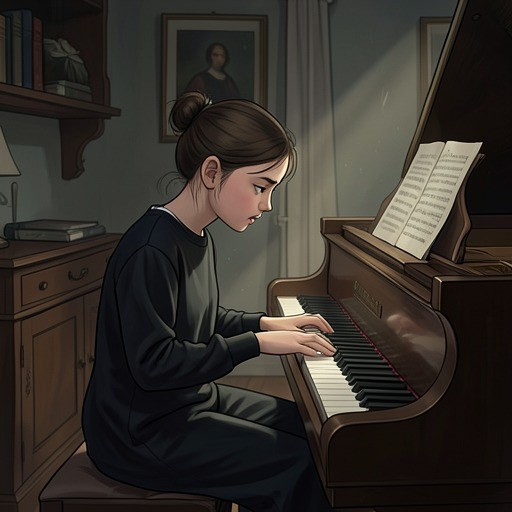
Elfrieda plays Rachmaninoff for the church elders
All My Puny SorrowsElfrieda Von Riesen’s performance of Rachmaninoff’s Prelude in G Minor, Op. 23, before a visiting delegation of East Village Mennonite elders becomes a decisive confrontation between her musical ambition and the community’s restrictions. Recalled by her younger sister, Yolandi Von Riesen, the episode is at once a performance, a challenge to religious authority, and the moment Yolandi later identifies as the beginning of Elfrieda’s departure from home.
The visit and the question of education
The confrontation takes place shortly after Elfrieda has marked the town with red paint. The bishop, described as the leading authority in the local Mennonite community, arrives on a Saturday with a group of elders. They travel in separate black cars and enter the family home in a slow procession. Though the bishop calls these encounters visits, Yolandi remembers this one as an intrusion. Her father, Jake Von Riesen, ushers the men into the living room and stands among them, visibly anxious. Their mother, Lottie, remains in the kitchen, washing dishes rather than coming forward to serve refreshments as convention would have required. Her refusal leaves Jake to face the delegation alone, despite her view that the elders have no right to arrive uninvited.
The stated subject of the visit is Elfrieda’s intention to study music at university. She is only fifteen, but the elders have heard from a local informant that she wants to leave the community. Their suspicion is directed particularly at higher education for girls: they fear that education will give her ideas. The visit therefore concerns more than a course of study. It places the family’s choices under communal scrutiny and makes Elfrieda’s future a matter the elders expect to influence.
The hidden piano
The piano at the centre of the episode has itself been kept against local convention. Pianos are technically forbidden in the town because they are associated with secular entertainment and unrestrained pleasure. Elfrieda’s parents brought one into their home after a doctor in Winnipeg recommended a creative outlet for her energy. For years, the family covered it with sheets and gunny sacks when elders came to visit. The parents eventually grew to value Elfrieda’s playing and sometimes requested familiar songs, including Moon River and When Irish Eyes Are Smiling.
The elders eventually learned that the family possessed the instrument. They discussed possible discipline for Jake, including a period of excommunication, but relented when he appeared willing to accept punishment. Their condition was that the parents ensure Elfrieda used the piano only as an instrument for the Lord. That compromise allowed the instrument to remain, but it did not remove the restrictions surrounding it. By the time of the visit about university, the piano represents both the family’s accommodation with authority and the artistic life that accommodation cannot fully contain.
The performance
While the elders speak with Jake in the living room, Elfrieda plays in a spare bedroom near the front door. She has worked on the prelude for two years with a conservatory teacher from Winnipeg, who drives to the house twice a week to give her lessons. Her family knows the piece in detail, and Yolandi recalls its complexity and emotional force. The elders stop talking as the music fills the house. In the kitchen, Lottie begins to hum and sway; the men remain silent while Elfrieda varies the volume of her playing.
The performance changes the terms of the visit without a spoken argument. The elders have come to discuss whether Elfrieda should be permitted to pursue higher learning; the music makes her ability and commitment present in the room. Yolandi describes her sister as taking control of her life in that moment. She also understands the playing as Elfrieda’s debut as an adult woman and, in retrospect, as the first sign of the world-class pianist she would become. These are Yolandi’s later interpretations of the scene, not evidence that the elders accepted Elfrieda’s plans.
Aftermath and significance
When the piece ends, Elfrieda closes the piano, scrapes the bench across the linoleum, and comes into the kitchen. She finishes the apple juice Yolandi passes her, throws the empty container away, and announces that she has finally mastered the piece. The elders file out in the order in which they arrived. Jake does not join his wife and daughters in the kitchen; he has gone to his study. The family’s ordinary movements after the music contrast with the larger change Yolandi sees taking place: her father has lost the elders’ approval, his authority within the household, and the daughter who is becoming free of their control.
Yolandi does not claim certainty about Elfrieda’s intention. She remains unsure whether Elfrieda knew that the elders were in the living room or whether she chose that moment by coincidence. That uncertainty keeps the scene from becoming a simple account of a planned challenge. Its significance lies instead in the effect of the performance: whatever Elfrieda knew, the music makes her artistic independence impossible to ignore. Yolandi calls the episode the moment Elfrieda left the family, although Elfrieda is still physically at home. The phrase marks a change in belonging and possibility rather than a literal departure.
The episode also takes place against a family history shaped by silence. Yolandi recalls that her grandparents came from a Mennonite village in Siberia in 1917, amid violence that drove surviving family members to Canada. Her grandfather warned the family not to teach the children Plautdietsch if they wanted them to survive, and Yolandi describes the language as carrying shame. Her mother later learned that suffering can pass between generations. The episode does not present that history as the direct cause of Elfrieda’s performance; it provides a broader contrast between inherited habits of silence and a young woman making her inner life audible. The piano, once concealed under coverings, becomes the means by which that contrast is heard.